RSGB Logo BOOKS

EXTRA!

Foundation Licence Now!
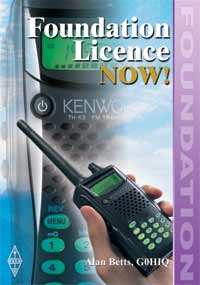

A companion page to Foundation Licence Now!, including: Updates, amendments, corrections, further information, component suppliers and web addresses.

All about the book and how to get your copy

Corrections, updates, further information and web sites


Updates to the 5th Edition, revised 2007.
The 5th edition has been reprinted with revisions in 2008, the changes from the 2007 edition are set out below.

Page 6, col 1 line 3.  Sentence rewritten to read:
The electricity flows out of the positive connection along the connecting wire, through the bulb and back along the lower wire to the battery's negative connection.

Page 6, col 1 para 2 line2:
Change force to potential

Page 6, col 1 immediately above ‘Power and Resistance’
Insert a new sub heading and text:
Conductors and Insulators.
The connecting wire we used to join the battery to the bulb is a conductor; it conducts electricity because the electrons can move freely. Metals are conductors.  The wire should also have a plastic sheath or covering.  That is an insulator, which does not conduct electricity.  The electrons cannot move in an insulator.  Wood, rubber, glass and ceramics are also insulators but if they get wet, the electricity may be able to flow through the surface water and still give you a nasty shock.  Be very careful in the wet.

Fig 3 now has arrows showing direction of current flow, to the right on the top (positive) wire and to the left on the bottom (negative) wire.

Fig 7 has the legend ‘time’ on the X (horizontal) axis and ‘amplitude’ on the Y (vertical) axis.

Page 23, col 1 para 3, line 2.  Sentence now reads:
If nobody does, then one more call might help somebody who was not sure they caught your call sign but further calls are unlikely to have more luck.

Page 23, col 1 para 4, last sentence now reads:
A call might be "CQ CQ CQ   CQ CQ CQ  This is M3ABC  M3ABC calling CQ CQ CQ M3ABC calling CQ".
Next para, first sentence now reads:
It is quite possible that this will not be heard the first time so only a second or two need be allowed before repeating the call.  It may well require many such calls before a reply is heard.

The changes on page 23 are intended to better draw out the difference between a VHF/FM and HF/SSB ‘CQ’ calls.  A call on a calling channel on FM is short and snappy, on HF SSB with no calling channel and the need to ‘net’ (tune in accurately), a longer and more persistent call is needed.

t.


RSGB Home Page

© 2001 Radio Society of Great Britain, Lambda House, Cranborne Road, Potters Bar, Herts, UK, EN6 3JE. Tel: +44 1707 659015. Fax: +44 1707 645105.

(www.rsgb.org)

This page was last updated on